
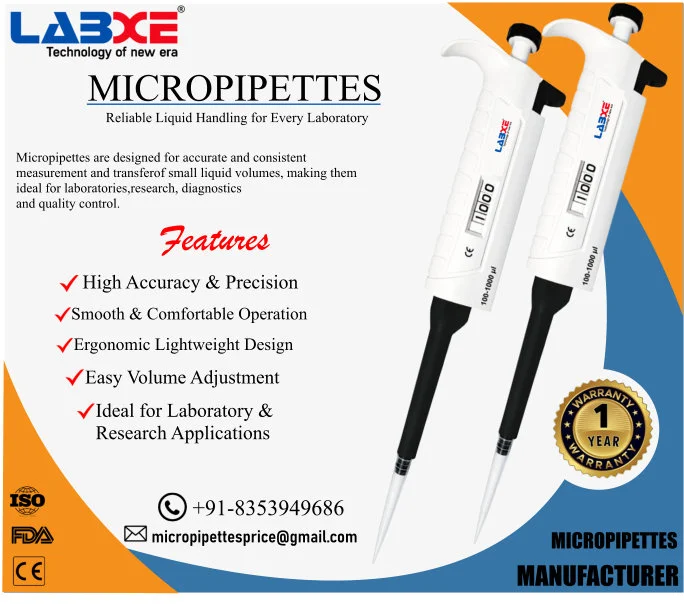
Micropipette Calibrated NABL in Andhra Pradesh – LABXE
Accurate liquid handling is an essential part of laboratory work. Whether it is used in pathology laboratories, pharmaceutical research, biotechnology, diagnostic testing, educational institutes, or quality-control facilities, a micropipette must deliver reliable and consistent volumes. For laboratories looking for a dependable micropipette calibrated NABL in Andhra Pradesh -LABXE, choosing a quality instrument and maintaining proper calibration can make a significant difference in everyday laboratory operations.
LABXE EXPORT PVT. LTD. focuses on laboratory instruments designed to support precise and convenient liquid handling. Its micropipette range is suitable for different laboratory applications and volume requirements. Along with selecting the right micropipette, regular calibration and verification are important for maintaining measurement confidence.
Why Micropipette Accuracy Matters in Laboratories
A micropipette is designed to transfer small quantities of liquid with controlled accuracy. Even a small variation in the dispensed volume can influence experimental results, reagent preparation, diagnostic procedures, and research observations.
For example, when a laboratory transfers a few microlitres of a reagent, an inaccurate volume can affect the concentration of the final solution. In repeated testing, these small differences may become more noticeable. Therefore, laboratories should pay attention not only to the quality of the micropipette but also to its calibration status.
A properly calibrated micropipette helps laboratory professionals achieve better consistency between repeated measurements. It can also support quality-control procedures where dependable liquid handling is required.
What Does Micropipette Calibration Mean?
Micropipette calibration is the process of checking whether a pipette delivers the intended volume within specified performance limits. During calibration, the actual dispensed volume is compared with the selected or nominal volume.
Calibration can involve gravimetric testing, where dispensed water is weighed using a suitable precision balance. Environmental conditions such as temperature, humidity, and evaporation can influence the measurement, so appropriate laboratory procedures are important.
Calibration is not simply about adjusting a micropipette. It is also about verifying its performance and identifying whether it continues to meet the required accuracy and precision.
NABL Calibration and Laboratory Confidence
NABL stands for the National Accreditation Board for Testing and Calibration Laboratories. NABL accreditation is associated with laboratories that demonstrate competence according to applicable accreditation requirements.
When laboratories search for a micropipette calibrated NABL in Andhra Pradesh -LABXE, they are generally looking for reliable calibration support and documented measurement confidence. It is important to understand that NABL accreditation applies to the calibration laboratory and its accredited scope, rather than being a permanent certification attached to every individual pipette.
Before arranging calibration, users should verify the calibration laboratory’s current accreditation status and scope for the required measurement range.
Choosing the Right Micropipette
Different laboratory procedures require different volume ranges. Selecting the appropriate micropipette can improve both convenience and measurement performance.
LABXE offers micropipette options covering commonly used laboratory volume ranges. Depending on the application, laboratories may consider models such as:
- P2: 0.2–2 µL
- P10: 0.5–10 µL
- P20: 2–20 µL
- P50: 5–50 µL
- P100: 10–100 µL
- P200: 20–200 µL
- P1000: 100–1000 µL
- P5000: 1000–5000 µL
- P10000: 1000–10000 µL
The correct model should be selected according to the actual working volume rather than choosing one pipette for every application.
Micropipette Applications in Andhra Pradesh
Laboratories across Andhra Pradesh work in several areas where accurate liquid measurement is important. Micropipettes may be used in diagnostic laboratories, pharmaceutical facilities, medical colleges, universities, research laboratories, biotechnology centers, food testing laboratories, and quality-control departments.
Common applications include reagent preparation, sample transfer, dilution procedures, molecular biology workflows, biochemical testing, ELISA-related work, and general laboratory experiments.
Because applications differ considerably, laboratories should evaluate volume range, ergonomics, accuracy, precision, tip compatibility, maintenance requirements, and calibration support before purchasing a micropipette.
Benefits of Using a Calibrated Micropipette
A calibrated micropipette provides several practical advantages for laboratory users.
1. Better Measurement Reliability
Calibration helps determine whether the instrument is delivering volumes within the required limits. This gives users greater confidence when performing routine liquid-handling tasks.
2. Improved Repeatability
Consistent pipetting technique combined with a properly maintained instrument can help reduce unnecessary variation between repeated operations.
3. Quality-Control Support
Laboratories following internal quality systems often maintain records related to equipment verification and calibration. Proper documentation can support laboratory quality procedures.
4. Reduced Experimental Variation
Accurate liquid transfer can help minimize volume-related variation in laboratory processes, especially when working with small quantities.
5. Better Equipment Management
Regular inspection and calibration can help identify instruments that require servicing, adjustment, or replacement.
Calibration Is Only One Part of Pipette Performance
Even a properly calibrated micropipette can produce inconsistent results if it is not used correctly. Operator technique has a major role in liquid handling.
Users should select compatible tips, avoid excessive force during pipetting, maintain appropriate immersion depth, use smooth plunger movements, and follow the manufacturer’s operating recommendations.
Pipette storage also matters. Instruments should be kept in a suitable position and protected from contamination, mechanical damage, and unsuitable environmental conditions.
Maintenance of Micropipettes
Regular maintenance can extend the useful life of a micropipette and help maintain reliable performance. Depending on laboratory use, routine maintenance may include cleaning external surfaces, inspecting the lower assembly, checking the tip cone, examining seals and O-rings where applicable, and identifying signs of leakage or mechanical problems.
If a pipette is frequently used or exposed to aggressive liquids, more frequent inspection may be appropriate. Damaged or contaminated components should be handled according to the manufacturer’s maintenance recommendations.
Calibration should also be scheduled according to laboratory requirements, frequency of use, risk assessment, and applicable quality procedures.
Why Choose LABXE Micropipettes?
LABXE EXPORT PVT. LTD. provides laboratory equipment with a focus on practical laboratory requirements. Its micropipette range is intended for users who need convenient and controlled liquid handling across different volume ranges.
For customers searching for micropipette calibrated NABL in Andhra Pradesh -LABXE, the most important consideration should be the combination of suitable equipment, correct usage, calibration verification, and proper documentation.
Before purchasing or calibrating a micropipette, laboratories should clearly communicate their required volume range and application. This makes it easier to select an appropriate instrument and calibration service.
Final Thoughts
Accurate pipetting is fundamental to dependable laboratory work. A good micropipette can make routine liquid handling easier, but calibration, maintenance, and proper user technique are equally important for achieving consistent results.
For laboratories in Andhra Pradesh, choosing the right micropipette according to application and volume range can support efficient laboratory operations. When calibration is required, users should check the credentials and accreditation scope of the calibration laboratory and maintain appropriate calibration records.
LABXE EXPORT PVT. LTD. offers micropipette solutions for laboratories requiring different liquid-handling volumes. If you are looking for a micropipette calibrated NABL in Andhra Pradesh -LABXE, consider the instrument’s specifications, intended application, calibration requirements, and long-term maintenance before making your selection.
Contact us:-https://www.go4worldbusiness.com/member/view/4750636/labxe-exports-private-limited.html